Once students can decode words accurately, instruction must expand
to how words function together in sentences—through subjects, verbs, and inflectional endings.
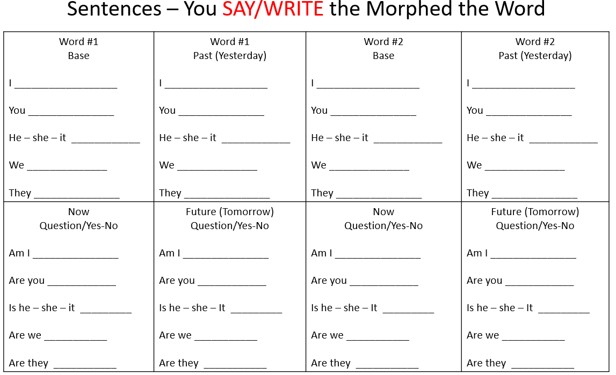
Using a Matrix - Click image to download PDF

Worksheet for Building Phrases - Sentences - Paragraphs
Using Inflectional Endings - Click image to download PDF.
From Word Accuracy to Connected Text
Teachers may use Artificial Intelligence (e.g., ChatGPT or Google AI Mode) to generatecontrolled word lists, sentences, or stories that match
specific vowel sounds, syllable patterns, or grade-level language demands.


Interactive Teacher Power Tools
Validate sentence ladders, analyze phonics patterns, and scaffold connected text for structured literacy instruction.

Low → Medium → High
reading passages.
story ladder progresses
correctly.

Low, Medium and High
versions.

phonics scope and
pattern violations.

(Visual Model )
Understand bidirectional processing
Text → Speech and Speech → Text
Pattern building and transfer
Teaching Flow
(Instructional Routine)
-
Step-by-step lesson structure
-
From word work to connected text
-
Built-in looping and review
Phonics Framework
-
Sound, syllable, and pattern alignment
-
Tier 1 (frequency) and Tier 2 (complexity)
-
Guides planning and differentiation
The Bridge: From Word Reading to Connected Text
Students do not abandon single-syllable patterns when words get longer or when text becomes connected.
This bridge supports the shift from accurate word reading (“word calling”) to reading words in relationship within phrases and connected text.
By carrying familiar vowel patterns, syllable structures, and spelling conventions into phrases and sentences,
instruction scales in complexity without introducing new decoding demands.Subjects, verbs, and inflectional endings provide the structure that makes this transition possible.
Categories
Short - Long
BossyR - Diphthong
Includes additional
section for
Inflectional Suffixes

Interactive Tool
Create Wordlists

3,500 words in 21 pages

Find Vowel - Find Last Sound - Find Beginning Sound
Click on picture to download.
3,500 words in 4 pages
- Find Vowel
- Find Last Sound
- Find Beginning Sound
If first letter is blue,
substitute other consonants.

Basic

Use with the Segmenting Tool if needed.
A vowel spelling may have more than 1 sound.
A
- Find the first vowel in the word you want to read.
- Find that first vowel in the top row.
- Find the vowel spelling in that column and click on it .
- Use the first letter to narrow the list.
- Find the word that matches the word you want to decode.
- Say the vowel sound for the vowel spelling.
- Blend all the sounds to decode the word.

I See - I Say
Wordlist
Decoding
Reading
I Hear - I Spell
Wordlist
Encoding
Spelling
- Listen for the vowel sound in the word you want to spell.
- Click on the picture matching the vowel sound.
- Use the first letter to narrow the list.
- Find the word you hear.
- Are there any homophones like brake and break?
Everyday Independant Use
Front Page I See-I SayBack Page I Hear-I Spell
Condensed Probabilies
Most 3-4 Common Results
All Probabilities
Use above tools to design explicit and differentiated activities, such as word sorts.
Use the segmentation tool in individual and/or small group work.
May be used with a Smartboard.
PDF is interactive.
SegmentationWorksheets
Print and/or interactive
All probabilities: I See and I Hear
Use with above tools

Matrix for adding s/es, er, ing and ed

Matrixes for adding Common Suffixes

Special Spellings for Ending Sounds
Special Spellings for Ending Sounds
Used for Single and Multisyllable Words
Create Explicit Wordlists
for 2 and 3 letter clusters:
beginning - medial - ending
Word database of 11,000 words
Interactive Tool
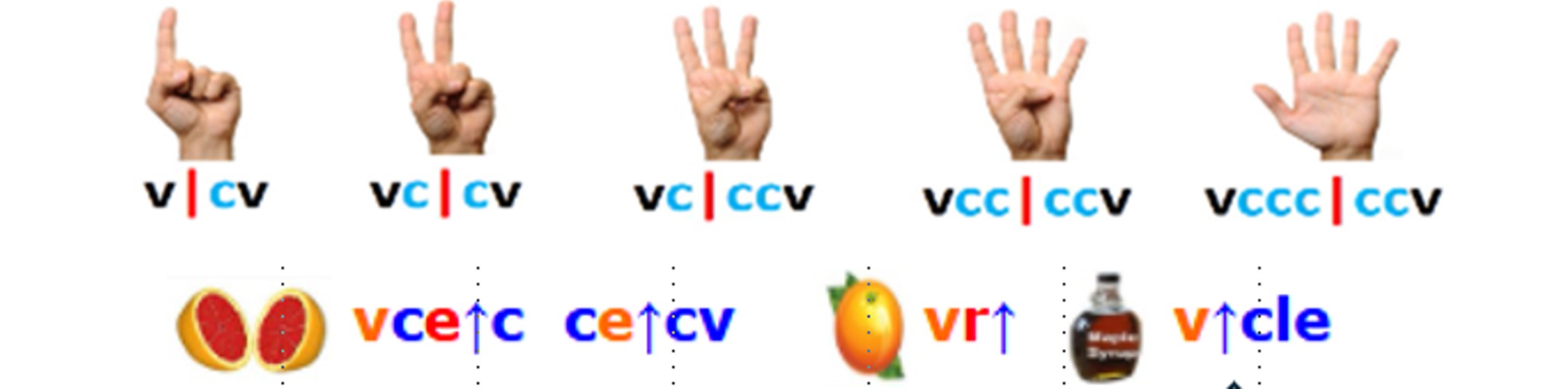
5 Finger Syllables and SPORGLE
1 Page
95 pages
11 Pages
New here?
Start with the Executive
Summary.
Quick overview?
View the 3-Step Infographic.
Ready to practice?
Use
I See – How Do I Say It.
Want the technical
reference? Explore the Technical
Reference.
These tools support chunking and syllable division in
multisyllablic words, allowing multiple patterns to appear naturally.
Full Wordlist Tool
2 - 9-Syllables
(5 Finger Syllables and SPORGLE)
-
Multiple vowel spellings at once
-
Ideal for exploration and analysis
-
Reveals patterns across the system
Interactive Word List
Single-Target Tool
2-Syllable Words
-
One vowel spelling at a time
-
Ideal for instruction and practice
-
High control, low cognitive load
Student JOB AID Teacher
Interactive Word List
These studies explain recurring spelling patterns across large sets of words,
helping teachers and students see structure that individual examples may hide.
These tools can be explored independently.
Full Wordlist Tool
2 and 3-Syllables
-
Multiple vowel spellings at once
-
Ideal for exploration and analysis
-
Reveals patterns across the system
Interactive List
-
2-syllable words: 3,500+
-
3-syllable words: 2,800+
Single-Target Tool
2-Syllables
-
One vowel spelling at a time
-
Ideal for instruction and practice
-
High control, low cognitive load
Student AIDS
Teacher
Interactive List
Tortoise & Hare: Decoding vs Encoding
Why spelling requires slower, more deliberate thinking than reading.
I Hear - How Do I Spell
These tools are used after the word is known or pronounced.
It explains how English spelling preserves syllable and
vowel structure even when sounds are reduced.
When Do I Double the Middle Consonant in Two-Syllable words?
Student/Teacher Job Aid
Pattern Analysis of
10,000+ two syllable words.
Interactive Tool
Create Wordlists
Twin Consonants:
Seeing Structure That
Speech Hides!
What Vowels Make the
Short u or Schwa (ǝ) Sound?
Interactive Tool
Create Wordlists
1st Syllable 299 - vowel is short u or schwa
2nd Syllable 825 - vowel is short u or schwa
3 syllable words:
1st Syllable 341 - vowel is short u or schwa
2nd Syllable 905 - vowel is short u or schwa
3rd Syllable 993 - vowel is short u or schwa